
A popular saying, especially on TikTok, referencing the well-known phrase: “Ah, these women!” It serves as an ironic, mocking summary of a statement or behavior considered stereotypically ridiculous or foolish. Additionally, using the tag #łymynmoment ☕, clips (movie snippets, memes, comments) are shared, and such situations are mocked.
The term refers to a scene from the game Team Fortress 2, which became a popular meme – a dialogue between two men sipping coffee and laughing loudly after saying “women”.
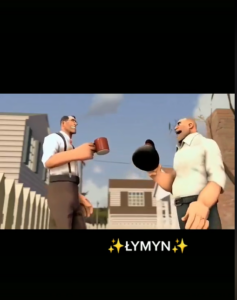
Source: https://www.tiktok.com/@mlody_matczaq77/video/7090606407317196038?is_from_webapp=v1&item_id=7090606407317196038
A negative event that evokes emotions, such as a scandal, argument, riot, etc. It is also a synonym for a party (see Miejski.pl).
Examples of usage:
[own translation]
Folks, another inba with Kurski
/https://www.facebook.com/OgladamWiadomosci/photos/a.199102730494217/98980296475
1. trip (Polish: ‘wycieczka, podróż’);
2. a state of intoxication after taking psychoactive substances
It is mostly used in the phrase ‘mieć tripa’ (Eng. to have a trip) meaning ‘1. to go on a trip, travel somewhere; 2. to be in a state of intoxication after taking psychoactive substances’.
Examples of usage:
1. […] we ate 50 mushrooms yesterday and had a beautiful trip […] /https://www.miejski.pl/slowo-Trip/
2. I’m riding with the middle schoolers on a bus. The adventure of a lifetime. “I can have a party today; I can even have a trip today. We’ll get high on acid. But will you have money?” /https://twitter.com/sle3va/status/469901404103266304/
3. I’m also going to have a trip to Warsaw hehe /https://twitter.com/ZUZIIKK_/status/1403253475702620163/
4. Mushrooms are dangerous because you can have a flashback trip at any moment, even weeks after taking them /https://twitter.com/fluffyzui/status/1306509514787741696/
5. But I will have a trip to Katowice tomorrow /https://twitter.com/PEPSlMANGO/status/1409241963589771271/
’lists of the best movies, songs, jokes, things; something that is in the highest place in the ranking’ A synonym for the expression top 10 or on top.
Usage examples:
’T-shirt, short sleeve shirt’
Use examples:
to be honest
Usage examples
A thick layer of make-up. A word also present in the language of the middle generation. See: tapeciara.
Usage examples
A girl with too much make-up, using too many cosmetics, applying tapetę (wallpaper) to her face.
Usage examples
No normal person would fall for this, because no normal person would date such a tapeciara. Some people just ask for it. I’ve never dated a girl who had so much make-up. /https://mobile.twitter.com/Stefan05991984/status/1403826161298415622/
I tried to do natural make-up and I think I’ll stick to being a tapeciara XD /https://mobile.twitter.com/schnappuccino/status/1402195711568056326/
A word so general that it can be adapted to many situations. It describes something exceptionally positive (‘cool, amazing, fantastic’ according to the definition of an internet user who submitted the word to the PWN Youth Word of the Year 2016 poll). Variants of the word include: sztosik and sztosiwo.
Example of use
– Look, what a cool (sztos) photo it turned out to be.
– Sztos! /conversation under photos posted on Instagram/
– Your blouse is sztos! /H/
‘An informer, whistleblower’. The name comes from Article 60 of the Penal Code on extraordinary mitigation of punishment and a minor crown witness (par. 3 and 4) and means a person who snitches, informs on others, testifies against them, protecting themselves. See: konfitura.
Reflections on the relationship between the ‘sześćdziesiona’ and Article 60 of the Penal Code can be read in the post Dogmas of the criminal on Facebook.com. See: https://www.facebook.com/dogmatykarnisty/posts/461011165370536
Examples of use:
term for food, a meal eaten at home or “out”. The word also appears in a diminutive form () – szamka.
The verb szamać is related to szama, which probably comes from the onomatopoeic, Proto-Slavic root *šam- / *šem- (cf. PSlav *šamati : *šemati (?) ‘to cause noise, rustle; to rub with something, to spin with something’). As indicated by the Great Dictionary of the Polish Language PAN, the meaning ‘eat’ is secondary, as it arose through “neutralization of the initially expressive definition of a loud way of eating food”.
The word szama also appeared in prison jargon, which led to the popularization of the word in slang and colloquial Polish.
Examples of usage:
pronunciation: [sueg] a unique, fashionable style, also a personality or attitude that can arouse admiration, also bragging about something, e.g. clothing, gadget or achievement, showing off. The word was borrowed from American slang. It was created from the word swagger, functioning as a verb ‘to behave in an arrogant or haughty pompous manner, to show excessive self-confidence; to boast, to be superior, to show off’, and also as a noun ‘arrogant behavior, boasting, self-confidence, showing off’, and even as an adjective ‘elegant, showy’ (see https://www.merriam-webster.com/dictionary/swagger#h2 and https://www.merriam-webster.com/words-at-play/what-does-swag-mean).
As you can see, the word swag has both positive and negative connotations. Currently, it refers primarily to people who want to shine in society by showing off a gadget or outfit, i.e. by doing swag. A person who does swag is called a swagger. Compare: drip, to drip with a drip.
Example usage:
A person who behaves in a suspicious way or whom we do not trust. An abbreviation of suspicious. A word often used by Among Us players. Pronounced sas.
Example of usage:
Mega SUS /chalk writing on a blackboard, class 7 SP/
jokingly about foot fetish and a person interested in e.g. photos of another person’s feet (intentional spelling mistake).
Example of use
A man considered a failure in life, a victim of fate, loser, who, on top of that, has no success with women. A contemptuous word, derived from the noun phimosis, meaning a disease of the male reproductive organ.
Usage example
A young stulejarz, Mirek, banged his fist on the table and decided to get out of przegryw, started going to the gym, taking care of his appearance and dressing well….
…unfortunately, Oskar Deweloperski and Sebastian Normicki also go to the gym, take care of their appearance and dress well, so despite the enormous effort, Mirek took, he will remain in the same place as he was – on the lower level of the sexual hierarchy 🙁 /https://www.wykop.pl/ludzie/st00ley/
A person taking stimulants.
Usage examples
’style, styling, interesting styling, favorite activities’ The phrase to have stilo describes a fashionable, stylish way of dressing and spending time, replacing the once popular – to have a style (cf. the song by the band Trzeci Wymiar. The form of the word refers to the pronunciation of the Italian stilo – ’rysik’, but in Esperanto the word stilo means ‘style’.
Examples of use:
The verb stanować means ‘to follow information about a favorite band, their new songs, and also to listen to the band’s music regularly’. A very popular word among fans of Korean popular music, or K-pop. The origins of the word can be found in Eminem’s 2000 song Stan. The name of the title character, an obsessive admirer of the artist and his work, gave rise to the slang term stan, referring to obsessive fans of a celebrity. This noun began to be used as a verb. According to some sources, who ignore Eminem’s song, the word stan is a combination of the words stalker and fan. See https://www.urbandictionary.com/define.php?term=Stan
Usage examples
The word comes from the English verb stalk ‘to follow, track’. It means ‘to stalk information or look for information about other people on social media’.
Examples of usage:
seriously [variants: srl/ srsly/ srly].
an abbreviation for the English word seriously used, usually ironically, to express surprise or disbelief. It occurs most often in the written, conversational variety of language, e.g. in posts, entries, online comments.
Examples of usage:
A spontaneous, unplanned action. See: na spontanie.
Example of usage:
Have you seen him in action? Full spontan and relax! /from a conversation between teenagers/.
Otherwise known as a sweater/tryhard. A player (gamer) who tries too hard or takes the game too seriously. The expression spocony gracz is a literal translation of the American slang expression sweaty gamer; tryhard.
A spocny gracz (actually a speedrunner, i.e. a gamer who wants to complete all levels of a game as quickly as possible) is depicted in the video meme /https://www.youtube.com/watch?v=Jb9Ebe_rA8M&ab_channel=BobuxDoesMemes/. The author of the viral video is youtuber H*ck No, who posted a humorous video entitled ‘Among Us but You’re Stuck With the Worst Task (Meme)’ on 3 October 2020. In the video, H*ck No tries unsuccessfully to complete a Card Swipe task for almost four minutes, with the webcam showing the youtuber sweating and quickly pressing keyboard buttons. The video has received more than 530,400 views in two months. Footage originally associated with the game Among US has become a meme used to refer to any online game (see https://knowyourmeme.com/memes/sweaty-speedrunner).
Example of use
It’s so funny that a spocony gracz Bastionu with a gold level was shitting all over everything because we were losing, and when he left we ended up winning the match X D /https://twitter.com/beggyslaw/status/1372590505968734209/
in other words, spocony gracz
Example of use:
It’s cool that the games I want to give up I win, and the ones where I tryhard like a fucking spoceniec I lose xD! /https://twitter.com/Exenon_/status/1316738878787682304/
Get your butt up, get moving, get your act together, get to work!
Examples of usage
A quarrel, an argument.
Example of use
– What’s their problem?
– I don’t know, they’re having some kind of spina (from a conversation between teenagers).
Examples of usage:
An abbreviation for the popular mobile app Snapchat, and a form of communication within it (video, photo).
Examples of usage:
The expression smash or pass originates from a game in which participants vote on who – shown in a photo or video, usually a celebrity or someone unknown to the participants – they find attractive and who they do not, literally: who they would like to have sex with and who they would ‘give up’ (2010). The expression has made its way into colloquial language and is used when judging someone’s appearance. Smash – pretty, I like it, I’m interested. Pass – I’m not interested, I don’t like it.
The expression smash tag also refers to the game Super Smash Bros. Ultimate, in which players earn smash tags, or special badges for certain achievements.
Example of usage
Something extremely tasty.
Example of use:
vegetarian pizza is a total smakuwa /https://twitter.com/HoshikoYukimura/status/1414201615691755522/
English: slay pronounced [slej] ‘to kill, put to death to knock down, in slang to make something great, delight, amuse’; an expression describing people, objects, experiences that cause admiration or are received particularly well. This includes the appearance of people, the course of events and interactions. In this context, ‘slay’ is synonymous with slang verbs: ‘wymiatać’, “rządzić”, “oddawać”. The word takes on additional expression in the saying: slay queen, denoting something special and unique.
Examples of usage:
‘to omit, leave out something, to skip’.
he verb is derived from English, where it means: 1. ‘’to skip, to leave out‘’ (ver.); 2. ‘’skip, leap” (noun.). In Polish it is formed with the suffix -ąć characteristic of singular verbs (e.g. zerknąć, trzepnąć) or, less frequently, stative verbs (e.g. chudnąć, blednąć). In slang, it expressively marks the rapid performance of an action (e.g. golnąć, dednąć, dupnąć).
Examples of usage:
to skip, to pick products out of a waste container’.
Derived from English – verb skip, noun. skip ‘rubbish container’.
See also skipnąć https://obserwatorium-mlodziezy.ujk.edu.pl/?s=ski
Examples of usage:
Skill (English: skill). A word used mainly by computer gamers.
Example of usage
Ok, but I have time to play for maybe 1.5-2 hours every third day and during the hours with the most traffic on the servers, it’s really hard to enjoy playing against the dudes who spend all their free time playing. Skil goes away so fast that you get discouraged. /https://twitter.com/Kamil52551975/status/1412697972014567424/
Socks.
Examples of use
[pronounced siuuu/ suuu]. An exclamation of joy caused by a win or particularly good news. The exclamation comes from Cristiano Ronaldo, who gave a shout after Real Madrid’s winning match against Chelsea London: ‘siiii’ ‘yes’. The exclamation soon became the basis for the characteristic ‘cieszynka’ (in football, it’s a display of joy), which for younger teenagers is not only the source of numerous imitations, but also a synonym for ‘essa’.
The word has been noted in English slang since 2021 (Urban Dictionary).
Example of usage:
Form of greeting. A shortened version of the greeting How are you? See: siemson.
Examples of usage:
Siema, Bartek! How are you doing? /overheard/
a humorous, playful response to a question about age or a replica in other phatic contexts (making and maintaining contact). This is an excerpt from a popular quote: On mi drink daje i chce robić ze mną jakieś dziwne akcje ‘Ile ty masz lat?’ (hehe) 17’ from the song by the group Natsu Word: NETERNAL. It refers to an online scandal (drama) involving Leksiu from Team X sending nude photos to a 14-year-old girl. He later explained that he did not know her age and that she appeared to be of legal age in the photos (see https://boop.pl/rozrywka/youtube/leksiu-z-team-x-oskarzony-o-wysylanie-14-latce-niestosownych-zdjec-i-wiadomosci).
The phrase was popularised not only by the song (https://www.youtube.com/watch?v=w3iiK2T9KnM), but through numerous reworkings on TikTok and YouTube; it became one of the most popular viral/ memes (see #aonmidrinkdaje).
Examples of usage:
[pronounced shish/ shis/ shiish] – is a borrowed exclamation from English (original: sheesh) that conveys the recipient’s reaction in the style of: Ah damn it’. According to the Merriam-Webster dictionary, the word expresses surprise, disappointment or irritation, and its first known use dates back to 1955 (see: https://www.merriam-webster.com/dictionary/sheesh#h1). The origin of the word is unclear, but many sources consider sheesh to be a euphemistic transformation of the exclamations Jesus, Jeez or shit (see https://www.thefreedictionary.com/sheesh, https://slang.net/meaning/sheesh).
The word began to spread on TikTok in early 2021 like a meme, when one of the service’s users posted a video clip of a frog being poured with water accompanied by audio of the word sheesh recorded in a high-pitched voice. In slang, it expresses, depending on the context – interest, surprise, amazement and even admiration or disapproval. It often occurs together with an emoji 😬🥶. See also: https://hypest.pl/sheeesh-co-to-znaczy-wyjasniamy-popularnego-mema/.
In face-to-face communication, it also serves as a kind of ‘groan of thought’ (replacing the not-so-young ‘yyy’), to mark contact or is used because – as younger teenagers say – it ‘sounds cool’. On the one hand, it is a matter of linguistic fashion, on the other, the sonic similarity to the aforementioned English vulgarity: shit, the public use of which is inappropriate.
Examples of use:
To reject someone as a lover, to make it clear that one prefers someone as a friend. See: friendzone.
Examples of usage
‘to take advantage of someone for material gain, an easy life or popularity and not suffer the consequences’.
The word comes from the nickname of popular Instagram and Tik Tok influencer and MMA fighter Fagata (Agata Fąk), and refers to the assessment of her behavior in relation to recordings of her conversations revealed by her former friend Masha Graczykowska, in which she admits to entering into relationships with men because of their wealth or popularity. Among those mentioned was one of Legia’s footballers and Fagata’s ex-boyfriend – a youtuber associated with Team X – Stuu (Stuard Burton). This statement caused a storm on the internet and voices of outrage from celebrities such as Sylwester Wardęga. Internet users accused the influencer of using Stuu’s sincere emotional involvement to promote herself on social media.
The phrase sfagatować kogoś (somebody), i.e. ‘to act like Fagata’, refers to one of the vocabulary trends in youth slang, related to the creation of eponyms (word pronouns), which refer to a whole category of behavior, usually with negative connotations, e.g. (z)sasinić, chajzerować, spewuenić.
Examples of usage:
A photograph taken of oneself, often for social media purposes. Known also as selfie, selfik, selfiak, selfiacz, selfiaczek.
Example of use
Can anyone tell me how much it costs to have 4-5 professional photos taken by a specialist? I need something for work and my face is not particularly presentable, so a samojebka is out of the question
https://www.wykop.pl/wpis/58928477/czy-ktos-moze-powiedziec-ile-kosztuje-zrobienie-4
The noun meaning female animal, in the environmental vocabulary has become synonymous with girl, woman, female friend.
‘(I have) the same; so do I’; synonym of rel. The word derives from English – same [pronunciation: seɪm].
Examples of usage
A compound derived from the words (sadism + masochism) denoting astonishment, disbelief expressed about a situation or behaviour very different from accepted standards. A pejorative, emotional or ironic assessment of an event or experience. Sado-maso (written with a dash) in colloquial language means sadomasochism, a psychological tendency directed towards experiencing sexual gratification from pain and humiliation both inflicted on the other person and experienced (Dobry słownik.pl).
Examples of usage:
A term for pathological or absurd incidents or situations that were recorded with a phone camera and published on the Internet. The place of action was usually a school. The subjects of these films were fights, brawls, drinking contests, obscene behaviour towards teachers or the bullying of other students. ‘Ruska szkoła’ was thus meant to refer to the naturalistic (brutal) truth about life in educational institutions. Nowadays, the phrase ‘Ruska szkoła’ is used more often to describe the ‘state of mind’ of a person or persons spouting nonsense or behaving absurdly. A synonym for ‘a bunch of idiots’.
Examples of usage:
A quick refreshment with deodorant or perfume. Synonym for ‘cygański prysznic (see https://slang.pl/cyganski-prysznic/).
Examples of usage
1. so called rumuński prysznic in lux version. 😉😁😁 https://twitter.com/WincEnigma/status/899209104534777856
2. -Are we going to make it after training? -Yep. Rumuński prysznic and let’s move on. /h/
A person with a romantic disposition, overly hypersensitive, emotional and delicate. Admirer of lyricism, tender stories, fond of moody atmospheres.
Examples of usage:
To win, usually by a large margin in a computer game, board game, sports competition or other type of competition. See: oro.
Sometimes the phrase to do oro also takes the meaning ‘great, very good, fit for something’.
Examples of usage
earn a lot; have a large income
Example of usage:
– Let’s go for a walk!
– No, dude, I have no free time. I have to still robić bankroll/papier/pengę
An acronym meaning ‘reason and human dignity’, or – depending on the context – ‘wisdom, zeal, ingenuity’. One can therefore be a man with RiGCZ /wisdom, resourcefulness and morality/ or do something without RiGCZ /foolishly, irresponsibly/.
The word comes from a comment that later became a pasta (shared online story), starting with the words: ‘Well I ask myself man, are you proud of yourself, do you realise what you’re doing? Do you even have the sense and dignity of a human being? (…) I don’t think you have even thought about what you are doing and who you are offending, you can offend those who deserve it, but not our Polish Pope’ (original text) on the subject of indecent memes and jokes on the Pope John Paul II.
Location: https://pastowo.com/paste/342/pl
Examples of usage:
 English
 Polski